




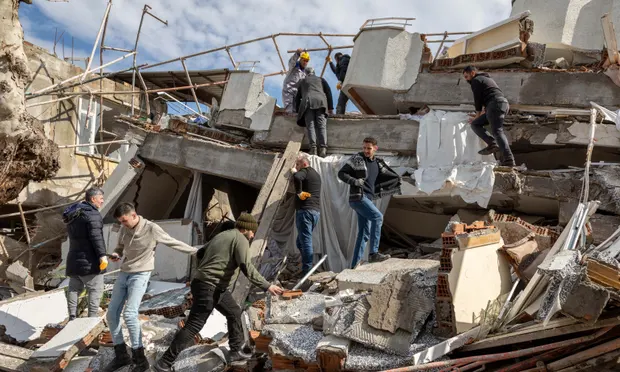
Turkey Earthquake: While Turkey’s Anatolian plate makes it one of the most earthquake-prone zones in the world, in the Indian subcontinent, the entire Himalayan belt also considered prone to great earthquakes of magnitude exceeding 8.0.
While Turkey’s Anatolian plate makes it one of the most earthquake-prone zones in the world, in the Indian subcontinent, the entire Himalayan belt also considered prone to great earthquakes of magnitude exceeding 8.0, the National Disaster Management Authority (NDMA) explained.
As much as 59% of India’s land mass is prone to earthquakes of different intensities. As per the seismic zoning map, the country divided into four seismic zones in which zone V is the most vulnerable while zone II is the least. Nearly 11% of the country falls in zone V, while 18% in zone IV, 30% in zone III and remaining in zone II.
As per a 2021 government report on seismic mapping of India, these Indian cities lie in the highest seismic zone V:

Has Turkey learnt the lesson?
The earthquake in Turkey came as a nightmare for the nation as the chilly winter night increased the misery on people. Turkey has seen many quakes in the past, including the one in December of 1939, when the country had witnessed a massive earthquake of magnitude 8.0 that struck near the eastern city of Erzincan. More than 20,000 were reportedly killed.
But has the nation learnt its lesson? If reports to believed, many buildings in Turkey century old and also made up of poor-quality materials. Reports have stated that those buildings, which constructed after the 1999 disaster are also not in line with earthquake safety standards.
Does India have an earthquake-proof building policy?
Yes, India does have. The seismologists have classified 59 per cent of the landmass of India as prone to earthquakes of different magnitudes—11 per cent in very high-risk zone V, 18 per cent in high-risk zone IV and 30 per cent in moderate-risk zone III.
Massive earthquakes will cause high-scale destruction of property and life. Hence, government authorities advise following certain guidelines while constructing buildings, houses and other infrastructures.
There’s also a list of Indian standards that deal with earthquake-resistant construction, which sheds light on the design of structures, construction of buildings, improving earthquake resistance of earthen buildings, repair and seismic strengthening of buildings.
But to what extent these guidelines being followed, especially in densely populated cities like New Delhi and Mumbai?
Read Also: 8,300 deaths from Turkey-Syria earthquake, miraculous rescue stories
SHARE


