




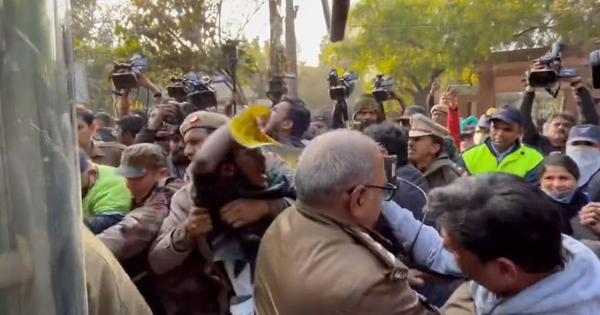
Students in India have clashed with police over the government’s decision to ban a BBC documentary about Prime Minister Narendra Modi and his role in Gujarat’s anti-Muslim riots in 2002. The documentary “India: The Modi Question” held the Prime Minister “directly responsible” for enabling the violence that killed 2,000 Muslims.
The Indian Foreign Ministry called the documentary “propaganda” and reportedly used emergency powers to have it removed from the internet.
What is going on in India?
Hundreds of students gathered at Jawaharlal Nehru University in New Delhi to watch the documentary, which organized by a student president and activist Aishe Ghosh. The university had threatened disciplinary action if the screening took place, claiming that it would disrupt campus peace. The power cut before the documentary could air, forcing students to watch it on their phones and laptops.
“The administration cut off the power,” Ghosh told Reuters. “We are encouraging campuses across the country to hold screenings in protest of this censorship.” According to the Students’ Federation of India (SFI), the documentary will shown in every state in India.
On Wednesday, several students at Jamia Millia Islamia University in New Delhi arrested after a screening was planned. According to the SFI, the detained students have yet to released from police custody.
The All India Student Association called for more protests and condemned the “brutality” of the police.
Reporters Without Borders’ Press Freedom Index currently ranks India 150th out of 180 countries.
Why was the BBC documentary banned?
Last week, the BBC released the first part of the two-part series, which highlighted a British government document that said Modi was “responsible” for the riots in Gujarat when he was the state’s chief minister.
The diplomatic report featured in the documentary stated that there had “widespread and systematic rape of Muslim women” and violence that “politically motivated,” all of which had the “hallmarks of … ethnic cleansing.”
The documentary not set to air in India, and the government made it difficult for residents to access it online.
After describing the documentary as a “propaganda piece designed to push a particularly discredited narrative,” the government blocked segments of it from YouTube and Twitter, implementing state censorship under the Information Technology Rules.
Unnamed sources told the digital liberties nonprofit Internet Freedom Foundation that both Twitter and Google’s YouTube had complied.
Read Also: What should investors do with their Adani’s Stock? Sanjiv Bhasin answers
SHARE


